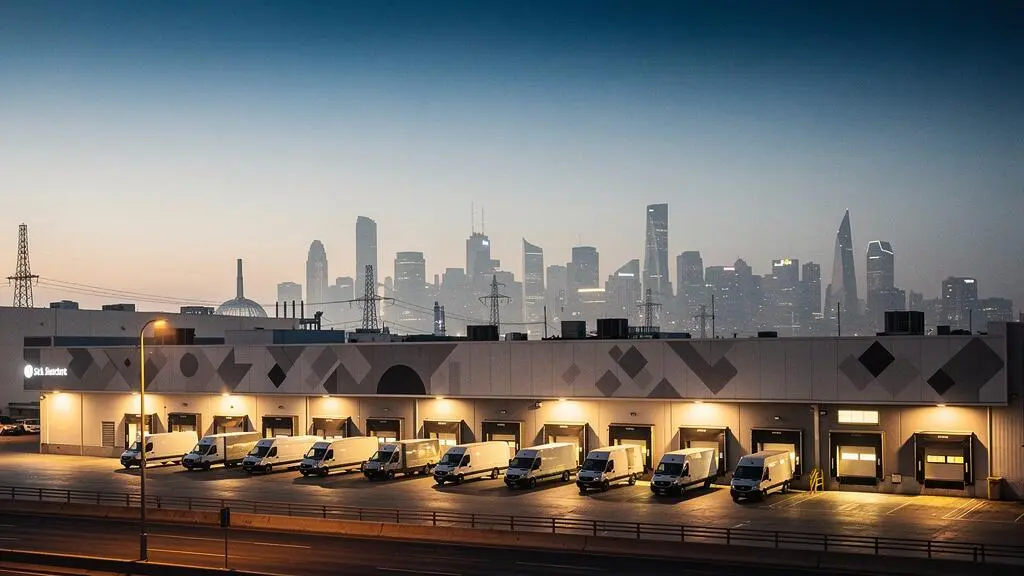
Profiting from the last-mile boom requires more than just buying near cities; it demands a granular risk assessment of the asset itself.
- ESG (Environmental, Social, Governance) compliance is no longer a “nice-to-have” but a key driver that dictates significant rental premiums and tenant demand.
- Tenant diversity is a crucial risk mitigator; multi-let industrial estates often offer a more resilient income stream compared to single-tenant “big box” assets vulnerable to a sole occupier’s failure.
Recommendation: Focus due diligence on future-proof assets with high power capacity for automation, verified ESG credentials, and structural adaptability, even if they command a higher initial price.
The constant stream of delivery vans in every neighbourhood is a visible sign of a profound economic shift. For savvy investors, it points directly to the booming asset class of last-mile logistics real estate. The common wisdom is simple: e-commerce is growing, so warehouses must be a good investment. This has led many to focus on basic strategies like acquiring properties near dense urban centres or investing broadly through REITs.
However, this surface-level approach overlooks the critical nuances that separate a profitable investment from a potential liability. The market is maturing, and the easy gains are becoming harder to find. Relying on macro trends alone is no longer sufficient. But what if the true key to success isn’t just identifying the trend, but mastering the granular, asset-level analysis that uncovers both hidden risks and future value? The most sophisticated investors are moving beyond location to dissect the properties themselves.
This guide provides an analyst’s framework for evaluating last-mile logistics opportunities. We will deconstruct the key factors driving value, from the fundamental economics of land scarcity to the complex risks of tenant profiles and business models. We will explore why green credentials command higher rents, how automation is reshaping building requirements, and what happens when your single, high-profile tenant goes bust. This is your guide to investing with precision in the logistics revolution.
This article provides a structured analysis of the critical factors to consider when investing in last-mile logistics real estate. The following table of contents outlines the key areas we will explore.
Summary: An Analyst’s Framework for Last-Mile Real Estate Investment
- Why Is the Shortage of Industrial Land Driving Rents Up in the Midlands?
- Green Warehousing: Why ESG Compliant Sheds Command Higher Rents?
- Big Box Logistics or Multi-Let Industrial Estates: Which Offers Better Tenant Diversity?
- The Single Tenant Risk: What Happens When Your Sole Logistics Tenant Goes Bust?
- How Will Warehouse Automation Change the Design Requirements for Future Assets?
- Why Does a New Elizabeth Line Station Boost Local Property Values by 10%?
- Retail Distribution vs D2C: Which Offers Better Margins for Physical Products?
- Subscription vs Transactional: Which Business Model Suits Your Service Best?
Why Is the Shortage of Industrial Land Driving Rents Up in the Midlands?
The fundamental principle of real estate investing—supply and demand—is playing out dramatically in the logistics sector. In core distribution hubs like the UK’s Midlands, the insatiable demand for warehouse space, fueled by e-commerce, is colliding with a finite supply of suitable industrial land. This imbalance creates intense competition among occupiers, giving landlords significant pricing power. This isn’t just a trend; it’s a structural shift where land itself becomes a primary driver of investment returns.
The data confirms this pressure. According to recent analysis, rents for large distribution warehouses have risen on average 5 per cent year-on-year in 2024. This rental growth is underpinned by the scarcity and high cost of land, with UK industrial land values holding firm at an average of £1.95 million per acre. The Midlands, in particular, has become the epicentre of this activity as companies consolidate their supply chains into centrally located, large-scale facilities.
This scarcity forces innovation and adaptation. Occupiers like Amazon are creatively solving this problem by converting functionally obsolete big-box retail stores into modern, last-mile staging centres. This strategy not only repurposes vacant real estate but also secures prime urban locations that would otherwise be unavailable for new development. For an investor, this signals that even seemingly overlooked brownfield sites or large vacant retail boxes can hold immense potential value if they are in the right location to serve the last-mile network.
Green Warehousing: Why ESG Compliant Sheds Command Higher Rents?
For years, ESG (Environmental, Social, and Governance) considerations in industrial real estate were seen as a marketing tool. Today, they are a powerful economic driver. Occupiers, under pressure from their own investors, customers, and regulators, are actively seeking logistics spaces that meet high sustainability standards. This demand has created a clear “green premium,” where ESG-compliant warehouses command significantly higher rents and attract better-quality tenants than their non-compliant counterparts.
The financial incentive is substantial. According to industry research, landlords can achieve a rental premium averaging around 12.5% for ESG-retrofitted warehouses. This premium is amplified by the fact that an estimated 61% of Europe’s warehouse stock is over a decade old, meaning much of it is functionally or environmentally obsolete. For investors, this creates a two-tiered market: modern, green assets that command top dollar, and older, inefficient assets that risk becoming unlettable without significant capital expenditure.
The willingness of tenants to pay for sustainability is not theoretical. It is a core part of their operational and financial strategy, driven by both cost savings from energy efficiency and the need to meet corporate sustainability targets. This table illustrates the clear occupier preference for compliant buildings.
| Metric | ESG-Compliant Warehouses | Standard / Non-Compliant Warehouses |
|---|---|---|
| Tenants willing to pay 0–3% rent premium | 74% | — |
| Tenants willing to pay 3–6% rent premium | 39% | — |
| European logistics vacancy rate (Q4 2024) | 4.8% | |
| Occupiers seeking a discount for older, non-compliant stock | — | Over a quarter of occupiers |
As the data from Clarion Partners’ research on European logistics highlights, over a quarter of occupiers are now actively seeking discounts for older, non-compliant stock. This is a critical risk factor. An investor acquiring a non-ESG asset today may face not only lower rents but also a shrinking pool of potential tenants and the high cost of a future retrofit.
Big Box Logistics or Multi-Let Industrial Estates: Which Offers Better Tenant Diversity?
From an analyst’s perspective, portfolio construction in logistics real estate often involves a choice between two primary asset types: large, single-tenant “big box” distribution centres and smaller, multi-let industrial (MLI) estates. While big box assets, often occupied by household names like Amazon or DHL, offer the security of a long lease to a credit-worthy tenant, they also carry concentrated risk. MLI estates, by contrast, spread that risk across a diverse roster of smaller tenants, providing a more resilient income stream.
The allure of big box facilities is strong, particularly in a hot market. The intense demand for these prime assets has led to significant yield compression. Research shows that in the North American market, for instance, demand for investment offerings strongly outpaces current supply, pushing capitalization rates down even for core assets. While this drives up asset values, it also means investors are paying more for each dollar of income, making the investment more sensitive to any disruption.
In contrast, MLI estates offer a different risk-return profile. The rent roll is diversified, meaning the failure of a single tenant has a limited impact on the property’s overall cash flow. This diversification often comes with higher management intensity but can provide more stable, long-term returns. Interestingly, prime rents for smaller units can be higher on a per-square-foot basis, as shown by the UK market data below.
| Asset Type | Average Prime Headline Rent | Annual Growth |
|---|---|---|
| Big-box (100,000+ sq ft) | £11.50 per sq ft | 5% y/y |
| Mid-box / Multi-let units | £14.80 per sq ft | 4.4% y/y |
The choice is not about which is “better,” but which aligns with an investor’s risk appetite. A big box asset can be a cornerstone of a portfolio if the tenant covenant is strong and the lease is long. However, an MLI estate offers a powerful tool for de-risking a portfolio through tenant diversification, a crucial defense against economic volatility.
The Single Tenant Risk: What Happens When Your Sole Logistics Tenant Goes Bust?
The scenario is an investor’s nightmare: you own a massive, state-of-the-art distribution centre leased to a single, seemingly invincible e-commerce giant. Then, overnight, that tenant declares bankruptcy or decides to consolidate its operations elsewhere. Your building, once a cash-flowing trophy asset, is now a vacant, capital-draining liability. This is the essence of single-tenant risk, and it is one of the most significant threats in logistics real estate investing.
This risk is amplified by the current market frenzy. The intense investor appetite for anything labeled “last-mile” has led to a dangerous trend where older, functionally challenged buildings are rebranded and sold at premium prices. As one expert warns, this can create a false sense of security.
Dr. Jennifer LeFurgy highlighted this issue in NAIOP’s Development Magazine, noting how savvy sellers are exploiting market hunger. The result is a severe compression of capitalization rates.
This has resulted in a compression of capitalization rates to the point that a 30-year-old warehouse in a desirable market often sells at similar capitalization rates as a three-year-old facility.
– Jennifer LeFurgy, Ph.D., NAIOP Development Magazine, Summer 2022
When you overpay for an older asset based on a single tenant’s lease, you are doubly exposed. If that tenant leaves, you not only lose your income but are also left with a building that may not meet the technical specifications of the next generation of occupiers, requiring a costly refurbishment or facing a prolonged vacancy. Mitigating this risk requires rigorous due diligence on both the tenant’s financial health and the asset’s long-term functional viability.
Action Plan: Due Diligence Checklist for a Single-Tenant Logistics Asset
- Tenant Financial Health: Conduct a deep dive into the tenant’s balance sheet, credit rating, and market position. Look for signs of financial distress or over-reliance on a single product line.
- Lease Analysis: Scrutinize the lease term, break clauses, and any co-tenancy provisions. How much time is left on the lease? What are the tenant’s options to exit early?
- Asset Adaptability: Assess the building’s specifications. Does it have sufficient clear height, power capacity, and yard space to attract a different tenant if the current one leaves?
- Market Re-letting Potential: Analyze the local market demand for a building of this size and specification. What is the average void period for similar assets in the area?
- Exit Strategy: Model a “worst-case” scenario where the tenant vacates. What would be the cost of retrofitting the building, and what is the likely sale price or new rental income you could achieve?
How Will Warehouse Automation Change the Design Requirements for Future Assets?
The image of a warehouse is rapidly shifting from rows of manual pickers to a highly choreographed dance of automated guided vehicles (AGVs) and robotic arms. This wave of automation is not just an operational trend; it is fundamentally rewriting the design and engineering requirements for logistics facilities. For real estate investors, this means an asset’s value is increasingly tied to its ability to support these next-generation technologies. A building that cannot accommodate automation risks becoming functionally obsolete.
Modern occupiers are prioritizing specific physical attributes that enable operational efficiency. According to recent market analysis, growth is concentrated in newer facilities as occupiers prioritize higher clear heights and greater power capacity to support automation and AI systems. These are no longer optional extras; they are core requirements for tenants looking to optimize their supply chains.
The key design changes investors must look for include:
- Higher Clear Heights: Automated storage and retrieval systems (AS/RS) operate vertically, requiring ceiling heights of 40 feet or more to maximize storage density.
- Increased Power Capacity: Robotic systems, charging stations, and data servers consume vast amounts of electricity. A building with insufficient power infrastructure is a non-starter for a modern logistics operator.
- Ultra-Flat Flooring: AGVs and other robotics require perfectly level and durable floors (measured by “FF/FL” numbers) to operate safely and efficiently at high speeds.
- Structural Reinforcement: Mezzanine levels designed to support heavy robotic equipment may require a higher floor load capacity than was standard in older buildings.
Acquiring an older building without these features can be a value trap. The cost of retrofitting—upgrading power, reinforcing floors, or even raising the roof—can be prohibitively expensive. Therefore, future-proofing is the critical investment lens. An asset’s long-term value will be determined not by what it is today, but by its capacity to adapt to the automated future of logistics.
Why Does a New Elizabeth Line Station Boost Local Property Values by 10%?
While last-mile logistics is often viewed through the lens of e-commerce, its value is deeply intertwined with a more traditional real estate driver: public infrastructure. The adage “location, location, location” is as true for warehouses as it is for homes, and major transport upgrades can dramatically enhance the value of industrial assets by improving connectivity for both goods and labor.
The Elizabeth Line in London serves as a powerful case study. This new railway line was not designed for freight, but its impact on the logistics ecosystem is profound. By increasing London’s rail capacity and bringing an estimated 1.5 million more people within a 45-minute commute of the city centre, it has massively expanded the labor pool available to logistics facilities located near its stations. For occupiers, access to a reliable workforce is a critical operational factor, making these locations far more desirable.
The tangible impact on local real estate markets is clear. One analysis of the Elizabeth Line’s effect showed that in areas like Abbey Wood, the new station led directly to a 6% rise in new homes and an 11% boost in employment access. The investment logic is straightforward: more jobs attract more tenants, more tenants drive higher rental yields, and superior connectivity fuels capital growth. This demonstrates that investing ahead of or alongside major infrastructure projects can be a highly effective strategy.
This principle extends beyond rail. The construction of new ring roads, port expansions, or even improvements to digital infrastructure like 5G networks can all serve as catalysts for logistics real estate value. An astute investor doesn’t just look at the building; they analyze the entire surrounding ecosystem and anticipate how planned infrastructure developments will enhance an asset’s strategic importance over the long term. This “value-add” is not something you build, but something you position your investment to capture.
Retail Distribution vs D2C: Which Offers Better Margins for Physical Products?
The business model of a tenant has a direct and significant impact on the type of logistics real estate they require. The two dominant models for physical products—traditional retail distribution (B2B) and Direct-to-Consumer (D2C)—create demand for vastly different types of facilities. Understanding this distinction is crucial for an investor looking to align their assets with the fastest-growing segments of the market.
Traditional retail distribution involves moving large quantities of goods from a central warehouse to a small number of retail stores. This model relies on large-scale, often rurally located, “big box” distribution centres. The D2C model, in contrast, involves shipping thousands of small, individual orders directly to customers’ homes. This requires a network of smaller, urban-infill facilities strategically positioned for the final stage of delivery. This is the domain of last-mile real estate, defined by experts as properties located within a 30-minute drive of dense population centres.
While D2C often offers brands higher profit margins by cutting out the retail middleman, it dramatically increases the complexity and cost of their logistics. In fact, last-mile logistics can account for over 53% of total shipping costs. The projected 78 percent surge in last-mile deliveries by 2030, as forecast by the World Economic Forum, is almost entirely driven by the explosion of D2C e-commerce. This is the tailwind that investors are chasing.
For a real estate investor, this means that while both B2B and D2C tenants need warehouses, the D2C segment is the primary engine of demand for the most valuable, and scarce, urban logistics assets. An investor holding a portfolio of well-located, smaller industrial units is directly positioned to benefit from the structural shift to D2C. Conversely, an investor in older, large-scale distribution centres far from population hubs may find their assets are serving a slower-growing, or even shrinking, segment of the market.
Key Takeaways
- Scarcity is a Key Value Driver: The finite supply of industrial land, especially in core hubs, is the fundamental economic force pushing up rents and asset values.
- ESG Compliance Is Non-Negotiable: A “green premium” is now a market reality. Assets without strong ESG credentials face lower rents, a shrinking tenant pool, and significant future costs.
- Tenant Risk Must Be Quantified: Diversification through multi-let assets can mitigate risk, while single-tenant properties require deep due diligence into both the tenant’s finances and the asset’s long-term adaptability.
Subscription vs Transactional: Which Business Model Suits Your Service Best?
Drilling down another layer into tenant risk, the occupier’s revenue model—whether it’s based on recurring subscriptions or one-off transactions—provides a powerful indicator of their stability and, by extension, the landlord’s risk. From an investor’s perspective, a tenant’s business model is a proxy for the predictability of their future rental payments. This level of granular analysis is what separates a speculative bet from a sound investment.
A tenant with a subscription-based model (e.g., a meal-kit service, a grooming products company) typically enjoys a predictable, recurring revenue stream. This translates into highly stable and forecastable demand for their products, which in turn means their need for logistics space is consistent and reliable. For a landlord, this type of tenant is ideal. They are less susceptible to short-term economic shocks and seasonal volatility, reducing the risk of default or early lease termination. Their stable operational footprint makes them a low-risk, long-term partner.
Conversely, a tenant with a transactional business model (e.g., a fast-fashion retailer, a seasonal goods seller) faces much greater revenue volatility. Their sales can fluctuate dramatically based on trends, seasonality, or consumer sentiment. This operational volatility can create instability in their real estate needs. They may require overflow space during peak seasons and then seek to downsize or sublet space during lulls. This makes them a higher-risk tenant, as their ability to meet long-term rent obligations is less certain.
Therefore, when evaluating a potential logistics asset, an investor should not only look at the tenant’s name but also at the fundamental mechanics of their business. An industrial estate leased to a diverse mix of subscription-based D2C companies may be a far more resilient and valuable asset than a single-tenant building occupied by a transactional retailer, even if the latter has a more recognizable brand name. This is the core of risk-adjusted investing in the modern logistics landscape.
To apply these principles, the next step is to begin evaluating potential assets not just on location, but on their specific risk-adjusted, future-proof characteristics.